Louisville Officer-Involved Shooting: Training, Tactics, and Split-Second Decisions

Setting the Scene
On May 30, 2026, Louisville Metro Police Officer Nathan Stotts responded to a rapidly evolving incident involving 27-year-old Martin Nitzken Jr., who was reportedly experiencing a severe mental health crisis.
Prior to police arrival, Nitzken allegedly assaulted multiple individuals, including his girlfriend and two friends. According to 911 callers, one victim suffered a bleeding wrist while another reportedly had chunks of hair pulled out during the altercation. After the victims fled the residence, Nitzken reportedly continued acting erratically throughout the neighborhood.
Witnesses described Nitzken running naked through the area, damaging property, and becoming involved in a physical confrontation with a neighbor. Multiple callers described his behavior as a "mental break" and stated he appeared to be experiencing a mental health crisis.
Officer Stotts arrived on scene alone approximately 90 seconds before the shooting occurred.
Body camera footage shows Nitzken naked in the roadway, behaving erratically and failing to comply with commands. The encounter ultimately ended when Officer Stotts fired a single round, striking Nitzken. Nitzken later died from his injuries.
The incident quickly drew national attention because Nitzken was unarmed at the time deadly force was used.
What We Know
Based on currently available information, several facts appear relatively undisputed.
Nitzken had allegedly committed multiple assaults prior to police arrival.
Numerous witnesses reported behavior consistent with a mental health crisis.
Nitzken was unarmed.
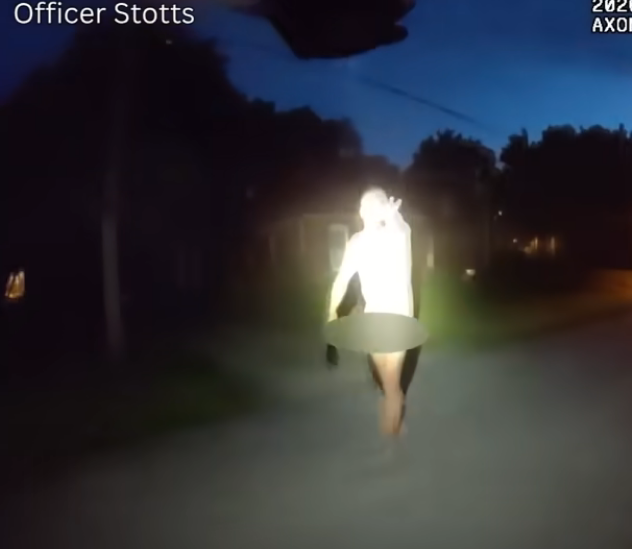
Officer Stotts was the first officer on scene and was alone during the encounter.
The encounter lasted roughly 90 seconds from the officer's arrival until the Officer-Involved Shooting
Less-lethal options were not deployed.
Body camera footage shows Officer Stotts repeatedly ordering Nitzken to stop moving and stop approaching him.
After the shooting, Officer Stotts remained at a distance with his firearm drawn until additional officers arrived.
Louisville Metro Police Chief Paul Humphrey later announced his intent to terminate Officer Stotts, stating the shooting did not meet department standards.
As with any critical incident, criminal and administrative investigations remain ongoing.
Tactical Breakdown
This incident presents several important tactical lessons for law enforcement officers.
The first is the impact of stress during high-risk encounters.
Officer Stotts was responding alone to a chaotic scene involving multiple reported assaults, erratic behavior, and an unpredictable subject. That type of call naturally creates stress and urgency.
When officers experience elevated stress, decision-making often becomes narrower. Officers begin focusing on what they perceive as the most immediate threat while unintentionally overlooking other available options.
That appears to be one of the primary concerns in this incident.
Throughout the encounter, Officer Stotts repeatedly tells Nitzken to stop walking toward him. However, when reviewing the footage, Nitzken does not appear to be aggressively charging the officer. Instead, the officer continuously retreats while Nitzken continues moving in the same general direction.
That distinction is important.
There is a significant difference between an active charge and a subject who continues advancing despite commands.
Neither situation is ideal. Both require intervention. However, they may justify very different force responses.
Another important factor is distance management.
At several points during the encounter, the officer appears to maintain enough distance to continue moving, create reactionary gaps, deploy a less-lethal tool, or potentially wait for additional resources.
Instead, the situation rapidly progresses to deadly force.
Finally, this incident highlights the importance of physical confidence and defensive tactics training.
Police officers routinely encounter unarmed individuals who are combative, resistant, mentally ill, intoxicated, or suffering from drug-induced crises. Officers must possess the confidence and skill set necessary to operate in that environment.
That does not mean recklessly fighting every suspect.
It does mean officers should be capable of recognizing when hands-on control, less-lethal tools, or coordinated team tactics remain viable options before transitioning to deadly force.
Key Takeaways
Stress can dramatically narrow an officer's focus and decision-making.
Less-lethal tools only help if officers recognize opportunities to use them.
Distance can be an officer's greatest ally during encounters involving unarmed subjects.
Defensive tactics and grappling skills create additional force options that may not exist for officers lacking confidence in their physical abilities.
Mental health calls often require patience, communication, and time whenever circumstances allow.
Once a threat has been stopped, officers should transition toward rendering aid as soon as it is reasonably safe to do so.
Legal Breakdown
Whenever an officer uses force, especially deadly force, the legal analysis generally begins with one case: Graham v. Connor.
In Graham v. Connor, the United States Supreme Court established that an officer's use of force must be judged under an "objective reasonableness" standard. Simply put, investigators, courts, and juries are not supposed to evaluate an officer's actions with the benefit of hindsight. Instead, they must evaluate the situation from the perspective of a reasonable officer on the scene at the time the force was used.
The Court also recognized that officers are often forced to make split-second decisions in tense, uncertain, and rapidly evolving situations.
That is an important point in this incident.
Officer Stotts was responding alone to a chaotic scene involving multiple reported assaults, an apparently mentally unstable individual, and rapidly changing circumstances. Any legal review must take those facts into account.
However, Graham v. Connor does not give officers unlimited authority to use force simply because a situation is stressful.
The question investigators will ultimately ask is whether a reasonable officer in the same circumstances would have believed that Martin Nitzken presented an imminent threat of death or serious bodily injury at the moment deadly force was used.
The fact that Nitzken was unarmed does not automatically make the shooting unlawful. Courts have upheld deadly force against unarmed subjects in situations where officers reasonably believed they faced a serious threat of bodily harm.
At the same time, the absence of a weapon remains a significant factor that investigators will examine.
Based on the available footage, several questions will likely become central to both the criminal and administrative investigations:
Was Nitzken actively attacking or attempting to attack the officer?
Did Nitzken present an imminent threat of death or serious bodily injury?
Was the officer creating distance, or was Nitzken actively closing distance in an aggressive manner?
Were less-lethal options reasonably available?
Would another reasonable officer have viewed deadly force as necessary under the circumstances?
Did the officer's actions comply with department policy, training, and accepted law enforcement practices?
One important distinction often missed by the public is that legality and policy compliance are not always the same thing.
An officer can be legally justified under Graham v. Connor and still violate department policy.
Likewise, an officer can comply with department policy and still face legal scrutiny if investigators believe the force was objectively unreasonable.
Based on the statements made by Louisville Metro Police leadership, the primary issue appears to be whether Officer Stotts reasonably exhausted or considered other available options before resorting to deadly force against an unarmed subject. That question will likely remain at the center of both the criminal and administrative reviews moving forward.
Bottom Line
This incident is not simply about one officer or one decision.
It is about training.
It is about recognizing available force options under stress.
It is about understanding when less-lethal tools should be considered.
It is about maintaining confidence in defensive tactics and physical control skills.
Most importantly, it is a reminder that mental health calls often require officers to balance public safety, officer safety, and the safety of the person in crisis, all while making decisions in real time.
Critical incidents will always occur.
The goal is not perfection.
The goal is ensuring officers have the training, confidence, and judgment necessary to recognize every available option before making a decision that cannot be taken back.


Comments