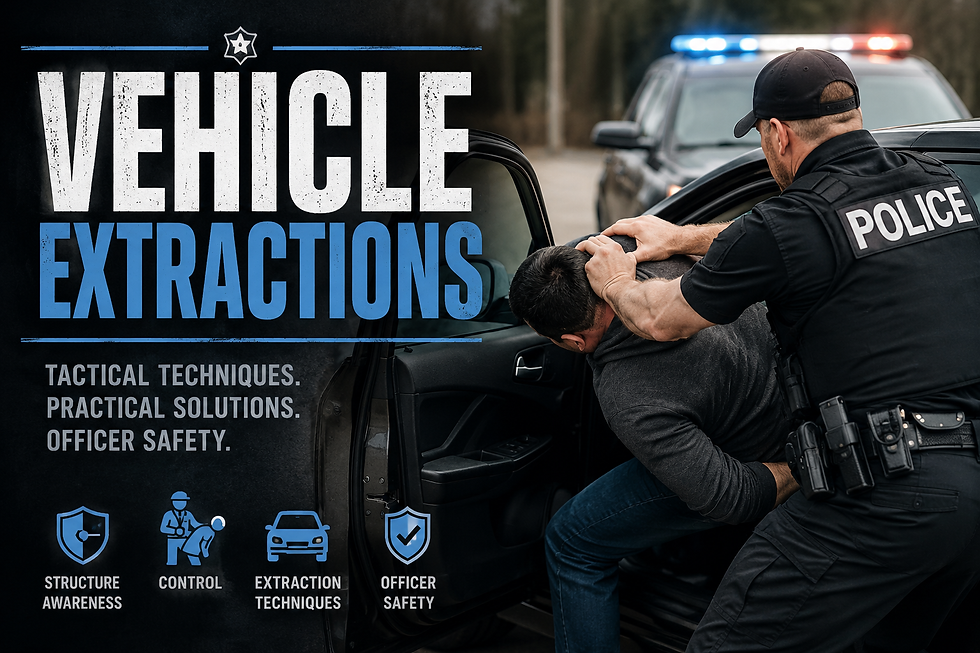
D.I.V.E. Handcuffing: Does Cuffing a Suspect Inside the Vehicle Create More Control or More Risk during a vehicle extraction?


Traffic stops are among the most routine tasks in law enforcement, but routine does not mean predictable. An officer may conduct hundreds of stops without incident before one driver suddenly decides to flee, fight, reach for a weapon, or use the vehicle itself as a weapon.
The Dynamic Interior Vehicle (D.I.V.E.) handcuffing technique was developed to address one of the most vulnerable moments during an arrest: removing an unrestrained person from a vehicle. Rather than ordering the driver out before handcuffing, D.I.V.E. calls for officers to secure both wrists while the driver remains seated, then remove the handcuffed subject from the vehicle.
Although D.I.V.E. has existed for years, it gained broader attention through a 2009 Police1 article by Deputy Al Cardarelli, who presented it as an option for arrests where custody had already been established, such as outstanding warrants or suspended licenses.
Like most police tactics, D.I.V.E. reduces certain risks while introducing others. This article isn't intended to declare the technique right or wrong. Instead, it examines how D.I.V.E. works, the advantages it may offer, and the potential concerns officers should consider before adding it to their tactical toolbox.
What Is D.I.V.E. Handcuffing?
The central idea behind D.I.V.E. is to handcuff the driver while they are still seated inside the vehicle rather than allowing them to exit completely unrestrained. The method uses the vehicle’s confined space to limit movement while the officer establishes control.
The basic D.I.V.E. sequence is as follows:
Step 1: Secure the vehicle.
The officer directs the driver to turn off the engine. Depending on the circumstances, the officer may also direct the driver to remove the keys or otherwise ensure the vehicle cannot be placed into motion.
Step 2: Control the driver’s left hand.
From the driver’s side of the vehicle, the officer takes control of the driver’s left hand and wrist. The officer maintains firm control and positions the hand for the first cuff.
Step 3: Apply the first handcuff.
The officer applies the first cuff to the driver’s left wrist while the driver remains seated inside the vehicle.
Step 4: Position the driver forward.
After the first cuff is applied, the officer directs and physically guides the driver forward toward the steering wheel. This positioning is intended to limit the driver’s ability to turn toward the officer or pull away.
Step 5: Direct the right hand behind the back.
The officer commands the driver to place the right hand behind their back. The officer should maintain control of the cuffed arm while closely monitoring the free right hand.
Step 6: Control the right hand.
Once the driver’s right hand is behind their back, the officer takes physical control of the wrist or arm and brings it toward the open handcuff.
Step 7: Apply the second handcuff.
The officer secures the second cuff to the driver’s right wrist. At this point, both hands are restrained while the driver is still seated inside the vehicle.
Step 8: Check and maintain control.
The officer confirms that both cuffs are properly applied and maintains control of the driver before beginning the extraction.
Step 9: Remove the handcuffed driver.
Only after both wrists are secured does the officer guide the driver out of the vehicle and complete the arrest process.


The Police1 article also describes variations of the technique. These include situations where the driver’s door is already open or where the officer initially begins the handcuffing process through an open window. For larger individuals or vehicles with limited interior space, the officer may apply the first cuff while the driver is seated, partially extract the driver, and then apply the second cuff.
However, that is a variation of the method. The primary D.I.V.E. technique involves securing both wrists while the driver remains inside the vehicle and removing the driver only after the handcuffing is complete.
The Problem D.I.V.E. Is Trying to Solve
Traditional arrest procedures often involve ordering the person out of the vehicle, positioning them away from the car, and then placing them in handcuffs.
That procedure creates space for the officer, but it also provides the person with mobility.
Once the driver is standing outside the vehicle, they can run, turn, square up with the officer, pull away, reach toward their waistband, or attempt to reenter the vehicle. Even a previously compliant person can suddenly decide that they do not want to be arrested.
There is also a psychological transition that occurs when a driver is ordered out.
A person may understand that a citation or conversation is taking place while seated inside the vehicle, but the moment they are told to step out, they may realize that they are about to be searched or arrested.
That realization can trigger resistance or flight.
D.I.V.E. attempts to act before that opportunity develops. Rather than asking the person to exit and hoping they continue complying, the officer immediately establishes physical control and completes the handcuffing while the person’s hips and legs remain restricted by the seat, steering wheel, doorframe, and interior of the vehicle.
The technique’s basic philosophy is simple: do not give an unrestrained person additional mobility immediately before taking them into custody.
The Advantages of D.I.V.E.
The strongest argument in favor of D.I.V.E. is control.
A seated driver does not have the same freedom of movement as a person standing outside the vehicle. They cannot immediately run, rapidly change direction, or use their full body weight as effectively. Their ability to turn and face the officer is also limited by the seat, steering wheel, center console, and the officer’s physical control.
Completing both cuffs inside the vehicle also significantly reduces the opportunity for a foot pursuit. A person who is already handcuffed before leaving the seat is far less capable of suddenly sprinting away once they reach the roadway.
The technique may also interfere with a person’s ability to prepare mentally for resistance. According to the original article, the speed of the initial control and application of the first cuff is intended to allow officers to complete the handcuffing before the subject’s fight-or-flight response can fully develop.
Another potential advantage is that the officer begins the extraction with the arrest substantially completed. Instead of attempting to control an unrestrained person in an open environment, the officer is removing someone whose hands are already secured behind their back.
That changes the balance of the encounter.
A fully handcuffed person may still kick, pull away, bite, or use their body weight. Handcuffs are not magic. However, the person has lost the free use of both hands before they are placed in a position where they can stand, turn, or run.
From that perspective, D.I.V.E. is a proactive tactic. It tries to deny the person an opportunity to resist effectively instead of waiting for resistance to begin and then reacting to it.
The Concern That Immediately Stands Out
The largest concern I see involves the driver’s right hand.
The first wrist secured under the D.I.V.E. method is generally the driver’s left wrist, which is closest to the officer standing outside the driver’s door. The driver’s right hand must then be brought behind the back and secured with the second cuff.
That creates a critical period where the driver’s right hand remains free.
The right side of the driver’s seat is also where many potential weapon-access areas are located. Depending on the vehicle, this may include the center console, cupholder area, space between the seat and console, passenger seat, floorboard, waistband, or an area beneath the driver’s thigh.
A driver who recognizes that an arrest is occurring may move that right hand from the steering wheel or another visible position toward a weapon very quickly.
D.I.V.E. attempts to manage that risk by pushing the driver forward and downward toward the steering wheel, controlling their shoulder, preventing them from turning toward the officer, and directing the right hand behind the back. The original article argues that controlling the arm above the elbow creates a mechanical advantage that prevents the person from turning toward the officer.
That may provide strong control over the person’s body, but it does not make the free hand irrelevant.
This is where officers must separate body control from weapon control.
An officer may have excellent control over the driver’s left arm and upper body while the driver’s right hand still has access to a firearm near the center console or seat. A person does not necessarily need to fully turn toward an officer to fire a weapon at extremely close range.
That does not make the technique automatically unsafe. It does mean that controlling the free hand must remain the central concern until the second cuff is secured.
The Confined Space Works Both Ways
Supporters of D.I.V.E. correctly point out that the vehicle restricts the driver’s movement.
The problem is that the vehicle may also restrict the officer.
An officer working inside a doorway may have limited room to move, limited visibility into the passenger compartment, and difficulty creating distance if the encounter suddenly becomes deadly. The steering wheel, doorframe, roofline, seat, and the officer’s own positioning can interfere with movement.
The officer may also be leaning partially into the vehicle while attempting to control the driver’s hands. That places the officer close to the driver and potentially close to any weapon inside the passenger compartment.
Distance provides time. D.I.V.E. intentionally trades some of that distance for physical control.
That trade may be worthwhile when the technique works as intended. However, when the subject resists or produces a weapon, the same confinement that limited the subject’s movement can make it more difficult for the officer to disengage, access equipment, move to cover, or respond with deadly force.
Traditional exit-and-cuff procedures generally provide the officer with more working space. D.I.V.E. generally provides earlier physical control.
Neither advantage is free.
What Happens After the First Cuff?
One important feature of D.I.V.E. is that the officer gains control of at least one wrist very early in the encounter.
That may create a meaningful advantage even if the subject begins resisting before the second cuff is applied.
A person with one hand secured to a dangling handcuff has lost some freedom of movement. The cuff itself may provide an additional control point, and the person’s ability to effectively use both hands together has been reduced.
If the person attempts to grab the steering wheel, pull away, or prevent the completion of the arrest, the officer may be able to maintain control, transition to another tactic, or disengage.
The original article specifically states that if the driver grabs the steering wheel and the officer cannot pull them free, the officer should disengage and recognize that the encounter has moved beyond routine handcuffing into an active fight.
That is an important point.
A technique should not trap an officer into continuing a failing plan.
Once a person demonstrates that they intend to defeat the arrest, officers must be willing to abandon the original technique, create distance when possible, communicate with assisting officers, and transition to a response appropriate for the resistance or threat being presented.
One cuff being applied does not mean the officer must remain attached to the person at all costs.
D.I.V.E. Versus a Traditional Exit and Cuff
Neither technique is inherently appropriate for every arrest.
A traditional exit-and-cuff procedure gives the officer an opportunity to visually assess the person’s waistband, movements, and general physical condition once they are outside the vehicle. It may also allow multiple officers to position themselves around the subject, maintain reactionary distance, and control the person in a more open area.
However, it also means the person exits completely unrestrained.
That creates an opportunity to run, fight, reach into clothing, turn on the officer, or attempt to reenter the vehicle.
D.I.V.E. reduces that opportunity by securing both hands before the person gains full mobility. However, the officer must enter close physical range and manage the dangers presented by the unseen or partially visible interior of the vehicle.
The traditional technique offers more distance and room to maneuver.
D.I.V.E. offers earlier restraint and reduced mobility.
The question is not which technique is universally safer. The question is which set of risks is more manageable under the circumstances confronting the officer.
Vehicle Design Matters
The phrase “inside a vehicle” covers an enormous range of working environments.
Handcuffing a cooperative driver inside a large pickup truck is not physically identical to handcuffing someone seated low inside a sports car. A driver in a compact vehicle may be pressed tightly against the center console. A larger person may have little room to move their hands behind their back. Some vehicles have high doorframes, narrow openings, large center consoles, heavily tinted windows, or interior configurations that limit an officer’s view.
The person’s physical size, flexibility, clothing, injuries, and mobility also matter.
The original D.I.V.E. article acknowledges this by providing an alternative in which the first cuff is applied while the person is seated, after which they are allowed to partially exit before the second cuff is secured. The person remains in a semi-seated position with their hips misaligned, theoretically keeping them off balance while the handcuffing is completed.
That variation reinforces the larger point: tactics must be adaptable.
A technique that works smoothly with one subject and vehicle combination may be awkward or unsafe with another.
Multiple Occupants Complicate Everything
The D.I.V.E. technique becomes more complicated when passengers are present.
An officer focused on controlling and cuffing the driver is operating at close range with their attention divided. A front-seat passenger may be only a few feet away. A rear-seat passenger may be partially obscured and capable of accessing a weapon without being immediately noticed.
Even if another officer is present, coordination becomes critical.
One officer may be responsible for the driver while another monitors the passengers, but the interior of a vehicle creates overlapping lines of sight and potential crossfire concerns. A passenger may also interfere physically, attempt to exit, move toward the officer, or create a distraction while the arrest is taking place.
D.I.V.E. may be most straightforward when dealing with a lone driver whose behavior, hands, and immediate surroundings can be reasonably assessed.
The presence of passengers does not automatically prevent its use, but it adds variables that should not be ignored merely because the driver appears cooperative.
Surprise Is an Advantage, but It Is Not a Plan
The original article places significant value on speed and surprise.
There is logic to that approach. A person who does not anticipate the immediate application of a handcuff may have less opportunity to tense, pull away, conceal a hand, or prepare to flee.
However, surprise should not be confused with safety.
The officer still needs a lawful basis for the arrest, a clear tactical plan, awareness of the person’s hands, and an understanding of the vehicle’s occupants and interior. Speed cannot compensate for failing to recognize a weapon, overlooking a passenger, or placing the officer in an unsustainable position.
The technique also relies heavily on decisive movement. Hesitation after initiating physical control may give the subject time to recognize what is happening and begin resisting while the officer is already committed at close range.
That means D.I.V.E. is not something an officer should attempt after merely reading an article or watching a short demonstration online.
The grips, transitions, body positioning, cuff orientation, communication, resistance responses, and disengagement options require hands-on training and repetition.
Otherwise, the officer is not performing a technique. They are improvising inside a car with one hand attached to someone who does not want to go to jail.
That is generally a poor time for improvisation.
Cooperation Can Change Quickly
The D.I.V.E. technique appears best suited for a person who is initially cooperative but has already been identified as someone who will be arrested.
That could include a driver with a confirmed warrant, a suspended license requiring arrest, or probable cause established during the stop.
The officer may have no specific reason to believe the person will resist, but still wants to prevent the person from gaining the opportunity to run or fight after exiting.
However, an initially cooperative person can change instantly once the first cuff is applied.
Some people comply until they realize they are actually being arrested. The sound or pressure of the first handcuff may become the moment that triggers resistance.
Officers using D.I.V.E. must anticipate that possibility before making contact. The position of backup officers, the status of the engine, the location of the keys, the person’s visible hands, the presence of passengers, and the officer’s route of disengagement should be considered before initiating the arrest.
The technique should not depend on the hope that the person remains calm.
Use of Force and Public Perception
To an uninformed observer, immediately grabbing and handcuffing a seated driver may appear abrupt or unnecessarily aggressive, particularly if the person was speaking calmly moments earlier.
However, the appearance of a tactic does not determine whether it was reasonable.
If an officer has lawful grounds to make an arrest, the officer is generally not required to allow the person additional freedom of movement merely because resistance has not yet occurred. Officers may use reasonable physical control to complete the arrest and prevent flight or resistance.
At the same time, officers should be able to articulate why the tactic was selected.
Saying, “That is how I was trained,” is rarely the strongest explanation. A better articulation would address the known arrest decision, the desire to control the person before they could flee or resist, the person’s positioning, the status of their hands, the presence or absence of passengers, and the officer’s assessment of the surrounding environment.
A sound tactic should be supported by sound decision-making.
The PoliceBreakdown Perspective
D.I.V.E. presents a practical solution to a legitimate problem. By handcuffing a driver before they exit the vehicle, it reduces opportunities to flee or actively resist during the arrest.
The tradeoff is that the officer gives up reactionary distance in exchange for immediate physical control. My biggest concern is the driver's free right hand until the second cuff is secured, particularly if weapons are accessible inside the vehicle.
For that reason, I don't see D.I.V.E. as a replacement for traditional vehicle extractions. I see it as another tool. It may be well suited for some arrests, but less appropriate when visibility is poor, multiple occupants are present, resistance is already occurring, or the vehicle's interior limits movement and access.
Ultimately, the question isn't whether D.I.V.E. is better than traditional vehicle extractions. It's whether the officer understands the strengths, limitations, and tradeoffs of both techniques well enough to choose the one that best fits the situation. That's the real value of studying tactics: not replacing judgment with technique, but expanding the options available when circumstances don't go according to plan.
Disclaimer
This article is intended for general discussion and educational analysis. It is not a substitute for hands-on training, agency policy, legal guidance, or instruction from qualified defensive-tactics personnel. Officers should follow their agency’s policies and approved training when conducting arrests or using physical control techniques.
Police1 Article below:

Comments