The Difference Between Active Resistance and Active Aggression


Setting the Scene
One of the biggest misconceptions surrounding police use of force is the belief that every person who resists arrest is actively trying to assault an officer.
In reality, there is a significant difference between active resistance and active aggression, and understanding that difference is critical when evaluating police encounters.
This distinction affects everything from officer tactics to use-of-force decisions, yet it is often overlooked by both the public and newer officers. Many controversial use-of-force incidents ultimately come down to whether an officer was dealing with someone who was resisting control or someone who was actively attempting to cause harm.
While both situations may require force, they are not the same thing.
Understanding that difference is important for officers, supervisors, prosecutors, defense attorneys, and citizens alike.
What Is Active Resistance?

Active resistance occurs when a person intentionally prevents an officer from gaining control but is not actively attempting to harm the officer.
In simple terms, the subject is creating a control problem.
Common examples include:
Pulling arms away during handcuffing
Refusing to place hands behind their back
Tensing muscles to prevent control
Grabbing onto objects or structures
Refusing to exit a vehicle
Rolling away while officers attempt to detain them
Running from officers
The key factor is that the person's actions are directed toward avoiding control, not causing injury.
That does not mean the behavior is acceptable or that officers must simply tolerate it. Active resistance often requires force to overcome. However, the goal of the subject is generally escape, avoidance, or non-compliance rather than assault.
This distinction matters because officers should recognize the problem they are trying to solve.
The objective is gaining control.
What Is Active Aggression?
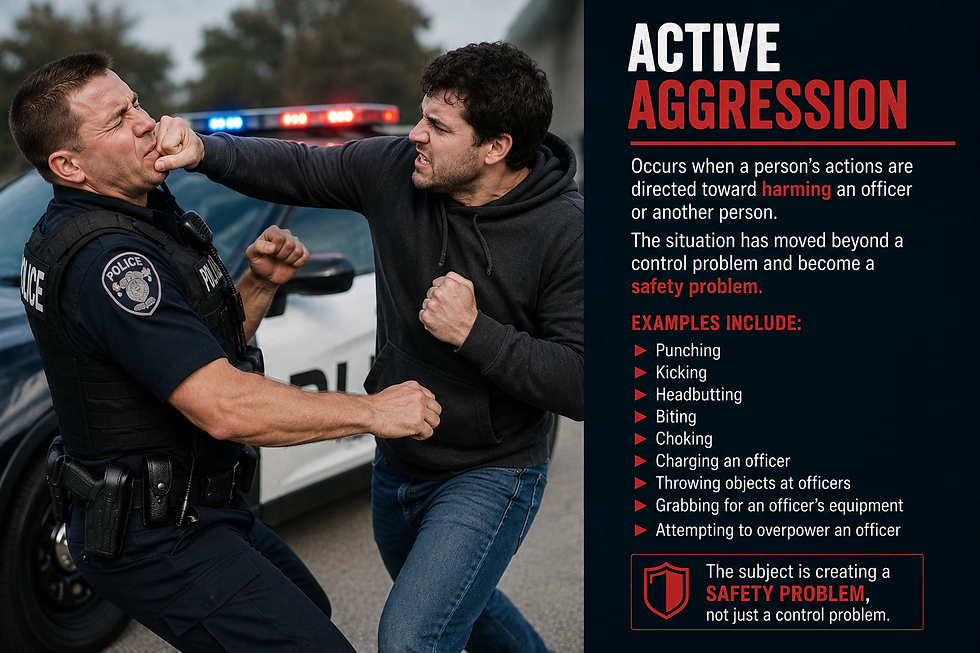
Active aggression occurs when a person's actions are directed toward harming an officer or another person.
At this point, the situation has moved beyond a control problem and become a safety problem.
Examples include:
Punching
Kicking
Headbutting
Biting
Choking
Charging an officer
Throwing objects at officers
Grabbing for an officer's equipment
Attempting to overpower an officer
These actions demonstrate an intent to assault, injure, or incapacitate.
The threat level changes significantly because the officer is no longer simply trying to gain compliance. The officer is now attempting to stop an attack.
That change often justifies a different force response.
Why the Difference Matters
To someone watching a body camera video, both situations can appear similar.
A person is yelling.
The officer is struggling.
Force is being used.
From the outside, it may all look the same.
But from a tactical standpoint, the difference is enormous.
Imagine a subject who pulls their arm away and refuses to be handcuffed.
That is active resistance.
Now imagine that same subject suddenly turns and punches the officer in the face.
That is active aggression.
The situation has changed.
The threat has changed.
The force options available to the officer may change as well.
This is why officers must constantly evaluate a subject's behavior rather than relying on assumptions. A person's actions can change in seconds, and officers must adapt accordingly.
The Gray Area

Not every encounter fits neatly into a category. In reality, many incidents move back and forth between active resistance and active aggression, sometimes multiple times within a matter of seconds.
For example, a subject may initially refuse commands, pull away from officers, or tense up during handcuffing. At that point, the officer is dealing with active resistance.
However, as the officer attempts to gain control, the subject may suddenly begin throwing punches, kicking, or otherwise attempting to injure the officer. The situation has now escalated into active aggression.
The reverse can happen as well. A subject who was actively assaulting an officer moments earlier may stop fighting and return to simply refusing commands or pulling away. When that happens, the threat level changes and the officer's response should change with it.
This is why force decisions are never static. Good officers continuously reassess the situation and respond to the behavior occurring in that moment, not the behavior that occurred ten or twenty seconds ago.
Just because a subject was aggressive earlier does not automatically mean they remain aggressive now. Likewise, a subject who is only resisting can quickly become aggressive if circumstances change.
Police encounters are fluid, unpredictable, and constantly evolving. The ability to recognize those changes and adjust tactics accordingly is one of the most important skills an officer can develop.
Common Public Misconceptions
If the person wasn't punching the officer, force wasn't justified.
This is one of the most common misconceptions.
A subject does not need to assault an officer before force becomes justified.
Active resistance often requires officers to use force to gain control and complete a lawful detention or arrest.
The level of force used must still be reasonable, but resistance alone can justify force.
If the person was resisting, officers can use whatever force they want.
This misconception is just as inaccurate.
Resistance does not give officers unlimited authority.
The force used must remain reasonable and proportional to the behavior being encountered.
Simply because someone is resisting does not automatically justify escalating to the highest levels of force.
Running away isn't resisting.
Running away is one of the most common forms of active resistance officers encounter.
The subject is intentionally preventing officers from gaining control.
While it may not be aggressive, it is absolutely resistance.
## What Officers Should Remember
One of the most important lessons officers can learn is to identify behavior rather than emotion.
A subject may be yelling, screaming, crying, cursing, or acting irrationally.
Those things alone do not tell you whether they are resisting or being aggressive.
Their actions do.
Focus on what the person is actually doing.
Are they trying to avoid control?
Or are they trying to cause harm?
Understanding that distinction helps officers select the appropriate tactics and force options.
It also helps officers articulate their decisions later in reports, interviews, and court proceedings.
Perhaps most importantly, it helps officers avoid overreacting to resistance while also avoiding underreacting to aggression.
Bottom Line

Understanding the difference between active resistance and active aggression is critical when evaluating police use of force.
A subject who refuses to cooperate creates a control problem.
A subject who attempts to harm an officer creates a safety problem.
While both situations may require force, they often require very different responses.
Good officers recognize that distinction, continuously reassess the situation, and adjust their tactics accordingly.
At the end of the day, the goal is not simply to win a confrontation.
The goal is to resolve the encounter safely, legally, and with the appropriate level of force necessary to accomplish the task.


Comments