Understanding Leadership in Policing and what can be done better.

To start, leadership is not just someone who has more time on the job than you, holds a higher rank than you, or orders people around. A leader is someone who builds people up, guides them, owns mistakes, and knows how to handle problems calmly and professionally.
From what I have personally seen, leadership in modern policing is a lot more similar to the regular workforce than most people realize. The difference is that in policing, leadership directly impacts officer safety, public safety, and decision making during high-stress situations. Poor leadership in this profession can absolutely get someone hurt.
And honestly, most officers know the difference between a leader and a supervisor almost immediately.
You can feel it within a few shifts.
Some supervisors make officers better. Others slowly destroy morale, confidence, motivation, and initiative without even realizing it.
In this post, I want to break down the good, the bad, and the reality of leadership in policing from my own perspective and experiences. I have seen firsthand what weak supervision can do to a squad, and I have also seen what strong leadership can do for morale, confidence, and overall performance.
Because at the end of the day, rank alone does not create leadership.

WHAT IS A LEADER VS A SUPERVISOR?
Most people probably think the two are the same thing, and sometimes they are. You absolutely can have a supervisor who is also a strong leader.
But in policing, and honestly most workplaces in general, there is usually a difference.
A supervisor often focuses on schedules, reports, policy enforcement, and operations. A leader focuses on the people actually doing the job.
That does not mean good leaders ignore standards or accountability. In fact, strong leaders usually hold people to very high standards. The difference is they understand mentorship matters just as much as discipline.
They do not abandon officers the moment problems arise. They teach. They correct. They guide. They develop people instead of simply managing them.
And trust me, officers notice that difference very quickly.

THE DIFFERENT TYPES OF SUPERVISORS
One thing I have learned is that not everyone who earns rank naturally becomes a leader.
Some absolutely do.
Others just become people with stripes or bars on their chest.
Over the years, I have seen several types of supervisors repeatedly damage morale, confidence, and squad performance.
The Micromanager
The micromanager has to involve themselves in every little detail.
Every report, every traffic stop, every investigation, every decision has to be done exactly their way or it is somehow wrong, even when the end result is still legally and procedurally correct.
Attention to detail matters in policing. I am not arguing against that.
But there is a huge difference between maintaining standards and trying to control every single aspect of another officer’s work.
Over time, micromanagers create hesitant officers.
Instead of building confident cops capable of making decisions independently, they create officers who constantly second-guess themselves because they are more worried about criticism afterward than the actual situation in front of them.
And in policing, hesitation matters.

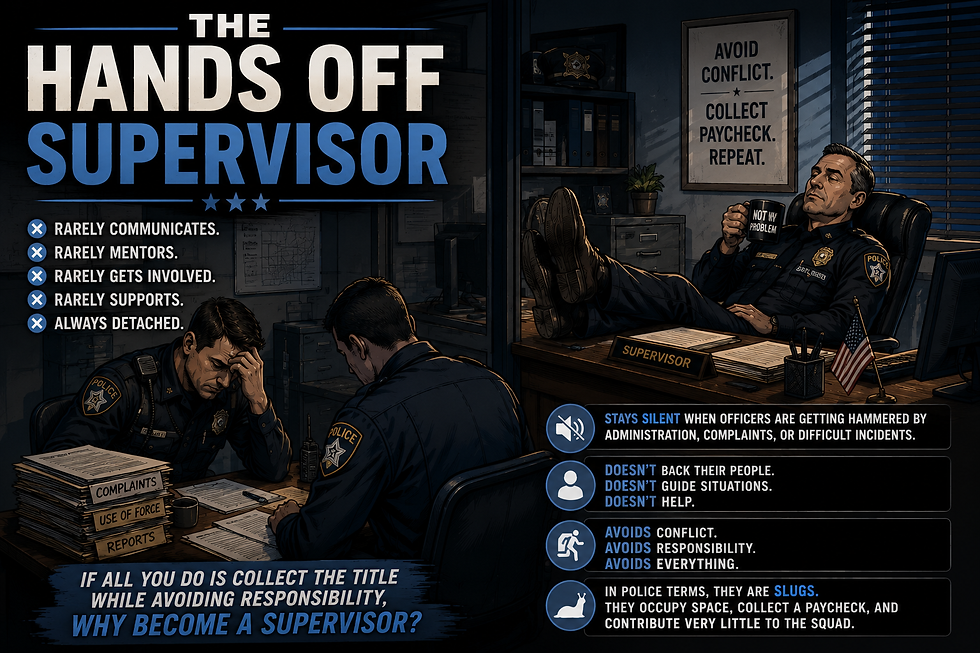
The Hands-Off Supervisor
This is the supervisor who technically holds the title but contributes very little beyond that.
They rarely communicate, rarely mentor, and rarely involve themselves unless absolutely forced to.
Most of the time they are detached from what is happening on the street.
What makes this type frustrating is not just the lack of leadership. It is the lack of support.
These are often the supervisors who stay completely silent when officers are getting hammered by administration, complaints, or difficult incidents. Instead of speaking honestly, backing their people when appropriate, or helping guide situations, they simply avoid conflict altogether.
And honestly, I think this is one of the worst types of supervisors in policing.
If all you are going to do is collect the title while avoiding responsibility, then why become a supervisor in the first place?
In police terms, these supervisors are basically slugs. They occupy space, collect a paycheck, and contribute very little to the squad actually functioning as a team.
The By-the-Book Supervisor
This supervisor follows policy exactly as written with very little deviation.
To be fair, many of these supervisors are not bad people at all. In many cases they are dependable, consistent, and still active in the field rather than hiding behind a desk all shift.
You generally know where they stand because everything comes back to policy and regulation.
The issue is that many struggle with actual leadership.
They supervise correctly on paper, but they do not always mentor, guide, or truly develop the officers under them. Their focus becomes avoiding policy violations instead of building confident and capable officers.
And policing cannot run on policy alone.
At some point, leadership, mentorship, and trust have to exist too.

The Soon-to-Be-Retired Supervisor
Every department has them.
This is the supervisor who has been on the job for decades and is simply trying to make it to retirement quietly.
Most are not terrible supervisors. They are just mentally checked out.
Their mindset becomes survival:
Keep the shift calm. Avoid attention. Avoid stress. Avoid complicated incidents.
And honestly, after 30 years in policing, I can understand why some end up that way.
Most are not eager to jump headfirst into an all-night shooting scene, a massive use-of-force investigation, or hours of administrative chaos.
They are just trying to finish their careers and go home.
The problem is younger officers still need leadership, guidance, and mentorship, regardless of where someone is at in their career.

The Buddy Supervisor
At first, everybody usually loves this supervisor.
Nobody is getting questioned. Nobody is getting corrected. Everything feels relaxed.
The problem is standards slowly start slipping because nobody wants to hold people accountable.
Small problems become bigger problems. Weak officers never improve. Lazy habits start spreading through the squad because nobody wants to upset anybody.
And eventually the entire shift starts operating without structure.
One thing policing taught me very quickly is this:
Being liked and being respected are not always the same thing.
A supervisor who is too focused on friendship usually struggles the moment real leadership is required.

WHAT ACTUAL LEADERS LOOK LIKE
Now on the other side of this, I have also seen genuinely strong leaders.
The biggest thing I notice about good leaders is that they build people up instead of tearing them down constantly.
They push officers to improve through training, mentorship, guidance, and accountability. They teach younger cops how to handle calls, write better reports, improve tactics, and stay calm under pressure.
And most importantly, they lead by example.
The Lead-From-the-Front Leader
These are the supervisors officers naturally respect.
They answer calls. They back officers. They jump into difficult situations. They do not disappear the second things become stressful.
They never ask officers to do something they would not do themselves.
And officers notice that immediately.
There is a massive difference between a supervisor watching chaos unfold from a distance and one actively standing beside their people while things are going sideways.

The Mentor Leader
This is the supervisor who actually develops officers instead of simply supervising them.
They explain decisions. They correct mistakes professionally. They help younger officers grow instead of humiliating them every time they mess something up.
I have personally learned far more from supervisors who took the time to explain things than supervisors who simply criticized everything afterward.
That mentorship matters.
Because younger officers are going to make mistakes. Every officer did at some point.
Strong leaders understand that building capable officers for the future matters more than feeding their own ego in the moment.

The Shield Leader
This leader understands when to correct officers and when to protect them.
They do not instantly throw officers under the bus the second pressure comes from administration, politics, or public opinion.
Now obviously, if an officer is wrong, they should be corrected. Accountability matters.
But good leaders also make sure fairness exists.
Officers trust leaders who they know will stand beside them when things become difficult instead of immediately disappearing to protect themselves.
And honestly, trust is everything in this profession.

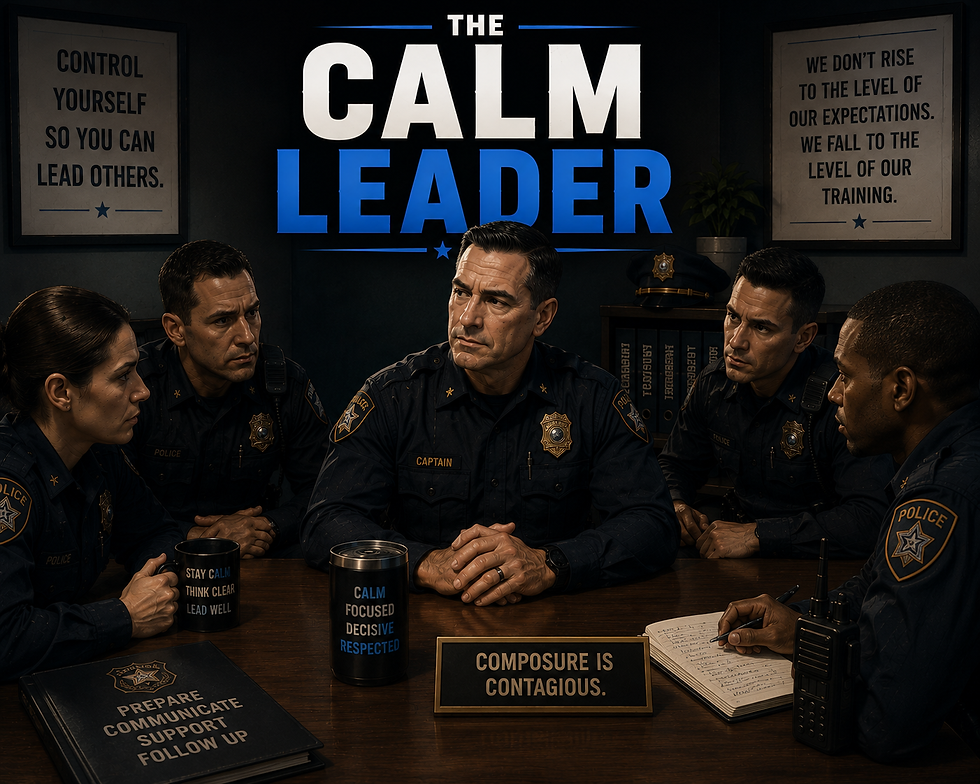
The Calm Leader
Some leaders stabilize scenes simply by how they carry themselves.
Critical incidents, chaotic calls, officer injuries, angry crowds, it does not matter. They remain level-headed and focused while everyone else is stressed.
And calmness spreads.
In policing, panic spreads fast, but so does composure.
A calm leader can settle an entire scene just through clear communication and confidence under pressure.
HOW BAD SUPERVISORS DESTROY MORALE
This is where leadership starts becoming dangerous.
Bad supervisors do not just hurt morale. They create hesitation.
And hesitation in policing can absolutely get somebody hurt.
When officers constantly feel unsupported, micromanaged, abandoned, or second-guessed, they eventually stop trusting their own decision making.
Instead of focusing completely on the threat or situation in front of them, officers start worrying about what happens afterward.
“Is my supervisor going to back me?”
“Am I going to get criticized no matter what I do?”
“Is this worth the risk?”
That mindset is dangerous in this profession.
Bad supervisors also kill proactive policing.
Eventually officers stop taking initiative because every decision starts feeling like unnecessary risk with no reward. Why make that extra stop, investigate suspicious behavior, or stay proactive if leadership disappears the second things become difficult?
Over time, motivated officers become burned out.
Younger officers stop trying to improve.
And entire squads slowly adopt the mentality of:
“Do the bare minimum and go home.”
Once that mentality spreads, morale collapses quickly.
Take this as a real example from my own experience.
I have personally seen officers bring a legitimate safety concern to a supervisor, only for that concern to get completely swept under the rug because addressing it would create paperwork, attention, and problems for the supervisor involved.
Without going into too much detail, this was not some minor complaint or petty disagreement. It was a serious concern that very realistically could have gotten someone hurt if it was not addressed properly.
Instead of handling the issue like a supervisor should, we were basically told it was “not their problem” and advised to handle it amongst ourselves.
And to be fair, we initially tried to.
But at the end of the day, supervisors are supervisors for a reason. If multiple officers are bringing forward a serious concern, especially one involving safety, leadership absolutely has a responsibility to address it instead of ignoring it because it is inconvenient.
Instead, the issue got pushed aside and nothing was done about it.

WHEN SUPERVISORS CREATE BAD COPS
A bad supervisor can absolutely create bad officers.
Maybe not intentionally, but through poor leadership, lack of mentorship, or lack of accountability.
Micromanagers create hesitation.
Hands-off supervisors allow weak officers to continue unchecked.
Buddy supervisors allow standards to collapse.
By-the-book supervisors sometimes create officers who are more afraid of policy violations than actual danger.
Officers adapt to the environment around them.
Good leadership creates confidence, professionalism, accountability, and initiative.
Bad leadership creates resentment, burnout, fear, laziness, and hesitation.
And in policing, that affects far more than morale.
It affects officer safety, public safety, and the quality of policing citizens receive.
Young officers especially are heavily shaped by the supervisors around them.
A younger officer who is mentored properly and pushed to improve will usually grow into a capable and confident cop. But younger officers who are ignored, unsupported, or left without guidance often develop terrible habits early in their careers.
And honestly, I think a lot of officers burn out from poor supervision long before they burn out from policing itself.

WHY GOOD POLICE LEADERSHIP MATTERS
Some of the best officers I have ever met were built by leaders who actually invested in them.
Leaders who trained with them.
Answered calls with them.
Corrected mistakes professionally.
Helped improve tactics.
Taught them how to talk to people.
Helped them navigate stressful situations.
They did not just sit behind a desk critiquing mistakes afterward.
They actually invested in their people.
A good leader also understands something many supervisors never learn:
Respect is earned, not demanded.
Officers can immediately tell the difference between somebody who simply holds rank and somebody who genuinely leads.
The best leaders are usually the ones who remain calm under pressure, admit mistakes, hold people accountable fairly, and never ask officers to do something they would not do themselves.
Those are the leaders officers willingly work hard for because trust already exists.

HOW CAN YOU BE A BETTER LEADER?
To start, being a leader comes with a long list of responsibilities, and as I have already said throughout this post, you do not need rank, stripes, or a special title to become one.
You can start being a leader within your own squad, sector, and even amongst your own coworkers. Sometimes leadership is simply being the officer who pushes others to improve, helps keep morale together, or steps up when problems start brewing.
All it really takes is initiative, consistency, and officers around you who are actually receptive to growth and improvement.
Now realistically, not everybody wants that. Some officers are simply slugs. They do not want to train, participate in sector activities, or improve themselves professionally. Honestly, if somebody wants to stay stagnant, there is only so much you can do.
At a certain point, you leave them be.
However, the moment that behavior starts becoming an officer safety issue on the street, it absolutely needs to be addressed. And personally, I think documentation matters. If serious concerns are being raised, especially repeated concerns, put it in writing. Emails create accountability, timestamps, and proof that the issue was brought forward.
Now verbal conversations still matter too. Pulling someone aside and addressing issues face-to-face is important, especially early on. But at the same time, paperwork protects you as well. If things eventually go sideways, documentation shows the concern was raised and attempts were made to correct the problem before it became something larger.
So how do you become a better leader yourself?
Start learning.
Take extra courses. Study laws and case law. Go to training. Learn tactics. Improve your report writing. Improve your communication skills. Become a resource for your squad or sector so when officers have questions, they know they can come to you for help or guidance.
Another major thing you can do is simply help the officers around you. If somebody is struggling, help them. If somebody is weak in an area you are strong in, teach them. That does not mean belittling people or acting superior. Nobody respects the guy who tries to lead through ego. Real leadership is being approachable, professional, and willing to help people improve without embarrassing them in the process.
Another thing strong leaders can do within a sector is organize and encourage training. That could mean setting up extra range days, studying defensive tactics, practicing breaching techniques, running officer safety refreshers, reviewing case law, or simply getting officers together to talk through scenarios and tactics.
Training does not always have to come directly from the department or formal instructors. Some of the best learning happens when officers push each other to improve and stay sharp outside of mandatory training days. Good leaders understand that skills fade over time, complacency creeps in fast, and the street does not care how long it has been since your last refresher.
If problems begin developing within your squad or sector, be willing to suggest solutions and help steer things in the right direction. But at the same time, remember there is a difference between leadership and supervision. Serious issues, especially issues involving officer safety, accountability, or repeated performance problems, ultimately need to be handled by actual supervisors. That responsibility exists for a reason.

FINAL THOUGHTS
At the end of the day, rank does not automatically create leadership.
A badge, stripes, bars, or a title may give someone authority, but leadership is earned through actions, consistency, accountability, and trust.
I have seen supervisors hold rank for years without ever truly leading anyone. I have also seen officers with no rank naturally become leaders simply because of how they carried themselves and treated the people around them.
Policing is already stressful enough without poor supervision making the job harder than it needs to be.
Officers need guidance.
They need accountability.
They need mentorship.
And especially younger officers need leaders who are willing to help them grow instead of abandoning them.
Because officers will always remember the supervisors who disappeared when things became difficult.
But they will also remember the leaders who stood beside them when it mattered most.


Comments