Disorderly Conduct arrest with a dog bite breakdown.

OVERVIEW AND SECTIONS IN THIS BREAKDOWN
SETTING THE SCENE
Late afternoon, April 22, 2026. The 200 block of North Locust Street in Florence is already locked down. A narcotics search warrant is being served by the Lauderdale County Drug Task Force, backed by SWAT and a K-9 unit. It is not a casual police presence. This is a controlled, high-risk operation with multiple units, roles, and responsibilities already in motion.
While that warrant is being executed, 46-year-old David Culliver walks into the perimeter. He is not part of the investigation. He is not detained. He is not even connected to the target location. But instead of staying clear, he inserts himself directly into the scene.
Culliver starts yelling at officers and moves into the roadway, forcing himself into an already unstable environment. Traffic is still moving. Officers give repeated commands to get out of the street. He ignores them. He steps back into traffic again, escalating a situation that was already tense.
At that point, the focus shifts. This is no longer just a warrant service. It becomes a public safety issue and a disorderly subject interfering with an active operation. Officers move to take Culliver into custody. He resists. Multiple officers attempt to control him, but the situation drags out longer than it should.
A K-9 is deployed to end it.
What follows is chaotic. Culliver fights through the apprehension, grabs the dog, and bites it. Officers respond with strikes to stop the attack and get compliance. He is eventually taken to the ground, cuffed, and removed from the scene.
What started as a controlled operation turns into a secondary use-of-force incident in the middle of the street. Not because of the warrant. Because someone chose to walk into it and push it.
WHAT WE KNOW
To start, officers are executing a narcotics search warrant by the Lauderdale County Drug Task Force, backed by SWAT and a K-9 unit. While on scene, a 46-year-old male, David Culliver, shows up and begins acting belligerent, yelling at officers.
Throughout the video, up to about 27 minutes and 26 seconds into the first officer’s bodycam, Mr. Culliver can be observed yelling obscenities and pacing back and forth across the street from the officers. During this time, he repeatedly walks into the roadway and even crosses over to the officers’ side of the street. He can also be heard claiming he is part of Homeland Security, while continuing to yell and act aggressively toward officers.
Officers give Mr. Culliver multiple commands to get out of the roadway and tolerate his behavior for over 27 minutes. Prior to the actual arrest attempt, Mr. Culliver approaches one of the officers, makes a direct threat by stating, “I’ll beat your fucking ass,” balls his fist, and lunges forward. Officers continue to tolerate the behavior, though they do ask if he has been drinking.
Based on the video, Mr. Culliver appears to be under the influence of alcohol or another intoxicant. His speech is slurred, and his statements are inconsistent and not coherent.
Ultimately, the officer seen sitting down, referred to here as Officer 1, stands up and tells Mr. Culliver he is under arrest and to turn around. Mr. Culliver responds by telling Officer 1 to “get the fuck off of me.”
At that point, the fight begins. Officer 1, along with another officer, Officer 2, attempts to take Mr. Culliver into custody. The struggle moves to the side of a black four-door car. During the fight, Mr. Culliver grabs Officer 1’s shirt while Officer 2 attempts to control him from the back.
The two officers continue to struggle until additional officers arrive: Officer 3 (in a black uniform), Officer 4 (who goes for the legs), and Officer 5 (the K-9 handler).
Officer 3 pushes Officer 2 out of the way and begins working to place Mr. Culliver’s left wrist into handcuffs. Officer 4 grabs Mr. Culliver’s legs, initially only securing one, and lifts it. This creates an opening, and Officer 5 deploys the K-9, which bites Mr. Culliver.
During the bite, Mr. Culliver grabs the K-9’s right paw, which prompts officers to escalate force. Officer 4 climbs onto the hood of the car and forces Mr. Culliver’s head down, using a pain compliance technique known as head displacement. This will be discussed further in the tactics section.
While Mr. Culliver’s head is being controlled, another officer, briefly seen in the video, delivers strikes to his chest. Mr. Culliver eventually releases the dog, but is given enough space to lean down and bite the K-9 on the back of the neck.
This prompts officers to deliver additional strikes until he releases the dog again.
After releasing the K-9, officers continue to struggle with Mr. Culliver for approximately another 40 seconds before finally taking him to the ground, placing him in handcuffs, and taking him into custody.
From start to finish, the physical struggle lasts approximately 2 minutes and 5 seconds.
TACTICS
In this section, we are going to go over the tactics, good and bad. To start, I’m not going to touch too much on the beginning portion of the video, mainly because the officers were just sitting there while Mr. Culliver was verbally belligerent.
There are two things from before the actual use of force that stand out as red flags.
The first is that Mr. Culliver, while primarily verbal, was moving around in an aggressive manner with an object in his hand.

I’m not saying officers should have immediately grabbed him up, but this is what I would call a red flag, or at least something that should prompt quicker attention. You have a subject directing anger at officers, pacing, holding an object that could be used as a weapon, in the middle of the street. That is a potential problem. Either address it early, or watch it closely like the officers did.
Now onto point two. Prior to the use of force, Mr. Culliver walks up to Officer 1, who is seated and speaking with him. On body cam, you can see Mr. Culliver yelling, getting in the officer’s face, balling up his fist, and even lunging to provoke a reaction.

I won’t harp on it, but allowing a subject to get that close, act aggressively, and lunge like that is a clear officer safety risk. From experience, if a fight is going to happen, it’s usually better to address it early rather than let it build into something worse.
The moment Mr. Culliver lunged with a balled fist into the officer’s space, that could have been addressed right there. It wasn’t, and that leads into the actual use of force.
Mr. Culliver then crosses back to his side of the street, continues being verbally aggressive, and specifically challenges Officer 1. He then starts walking back toward the officers. Officer 1 stands up and attempts to place him under arrest.

In the attempt, Officer 1 walks up behind Mr. Culliver. It’s important to note that Officer 1 had already verbally told Mr. Culliver he was under arrest, but those commands were ignored as Culliver continued walking away.
In the photo above, Officer 1 has a clear opportunity to close distance and take control, assuming he has the training to do so.
A leg sweep or a double leg takedown could have been used to bring the subject to the ground onto his stomach.
Another option would be to fully engage from the back, control the arms, and then sweep the legs to bring him down.
With any of these techniques, they have to be done fast and with commitment. If you hesitate or go halfway, they fail.
Instead, Officer 1 reaches for Mr. Culliver, who pulls away and turns to face him. Officer 1 attempts to grab him again, but Culliver grabs the officer by the shirt under both arms. A second officer comes in from behind, and the three move toward the driver’s side of the black car.
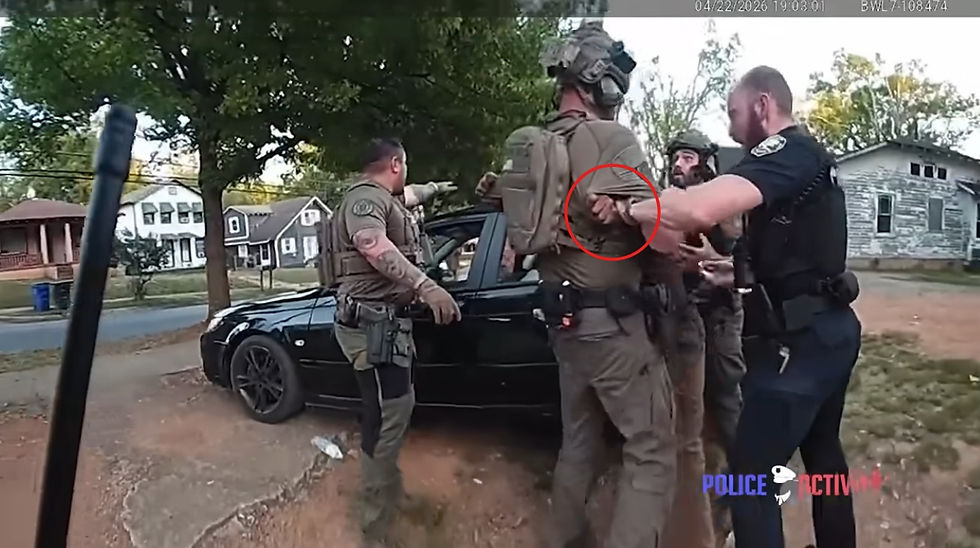
In the image above, you can clearly see Mr. Culliver grabbing Officer 1’s shirt. You can also see Officer 2 (on Culliver’s back), Officer 3 (in black), and Officer 4 (to the left).
From a tactics standpoint, the priority here is obvious. Break the grip. You have to address the hands. As long as Culliver is holding onto Officer 1, you are not getting cuffs on, and any movement is going to be transferred through that grip.
Another piece to understand here is how the use of force matrix applies to this situation. If you want a deeper breakdown, I have an article covering it in detail.
Check it out here------>Decoding the Use of Force Continuum in Policing: Use of Force Explained
That said, the moment Culliver grabs Officer 1, he becomes actively aggressive. That gives justification to strike the subject in the body or face to break the grip if needed. The risk is obvious. He can release one hand at any time and start throwing strikes. Instead, officers continue to struggle with him without addressing it directly.
Rather than dealing with the hands, all four officers stay tied up in the fight. Officer 3 (in black) moves Officer 2 out of the way and starts working to get Culliver’s left wrist into cuffs, and he is successful in securing one side.
At the same time, Officer 4 grabs Culliver’s legs and lifts them.

This leg lift creates a clear opening for Officer 5 (K-9 officer) to deploy the dog, which engages on Mr. Culliver’s leg.
There’s a lot to break down here from a tactics standpoint.
First, there is an officer standing by and not actively assisting.
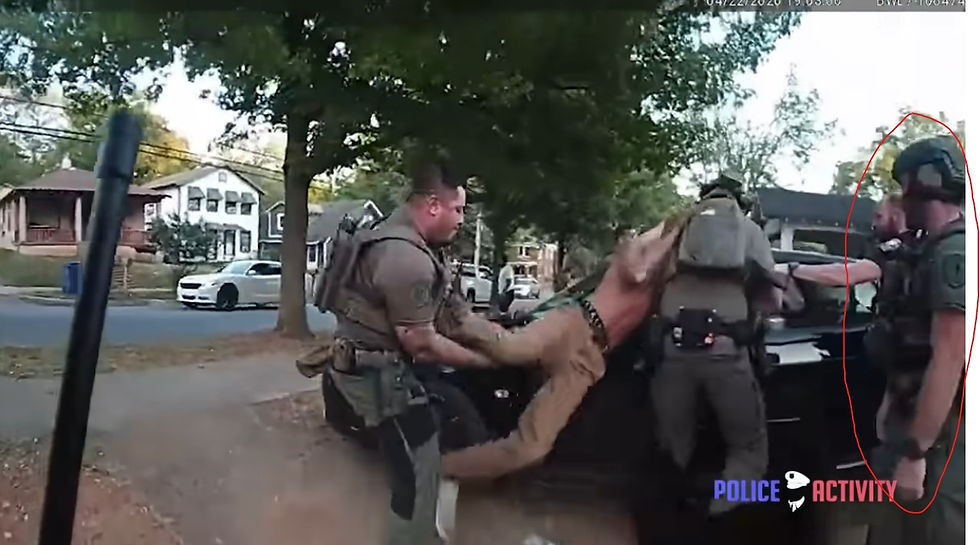
The reality is this. If an officer is actively fighting a subject, you do not stand there and do nothing. There is always a role. This officer could have assisted with controlling Mr. Culliver’s right arm or helped get him to the ground and away from the car.
The second issue is Officer 3 (in black) working with one arm while trying to get Mr. Culliver into handcuffs.
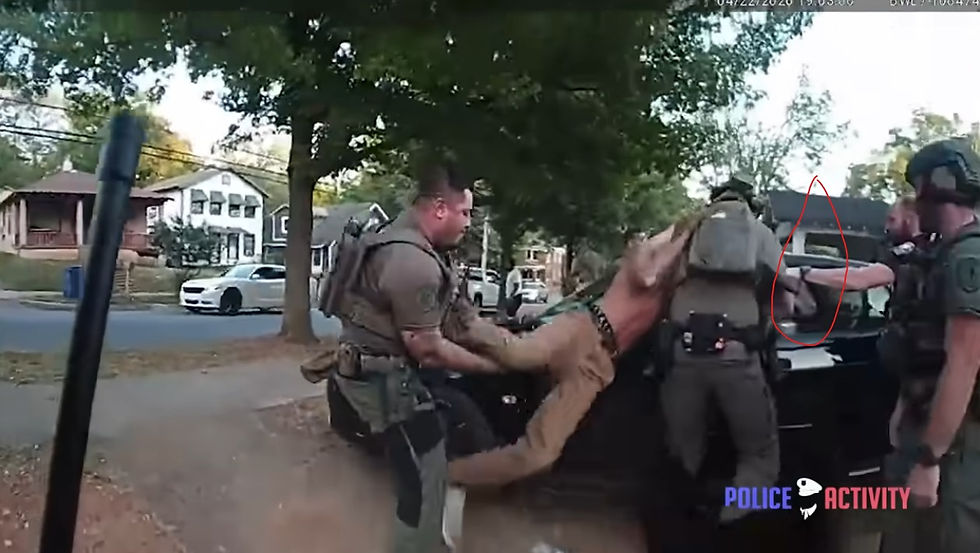
Working with one arm on a resisting subject is a disadvantage. You’re always going to be stronger and more effective using both hands. To be fair, he’s not standing idle and is serving a purpose, but that purpose would be far more effective with proper two-hand placement and control.
The last point in this section is Officer 4 (on the legs). The leg drag itself wasn’t bad. It could have taken Mr. Culliver to the ground, but that’s not what happens.
Instead, Officer 4’s movement creates the opening for Officer 5 (K-9) to deploy the dog, which engages on Mr. Culliver.
K-9s are a solid tool for taking a suspect into custody, but in a situation like this, with five officers on scene and multiple already hands-on, it may not be the best option. You increase the risk of a cross bite, and you limit your ability to move and transition while the dog is engaged.
Moving forward, once the K-9 bites, Mr. Culliver grabs the dog’s right paw.

Once Mr. Culliver grabs the K-9’s paw, officers react quickly and begin delivering strikes to get him to release. At the same time, Officer 4 moves onto the hood of the car and uses head displacement in an attempt to break Culliver’s grip on the dog’s paw.

From a tactics standpoint, this is a strong move and one you don’t see used enough. Speaking from experience, a lot of officers either don’t know it or don’t apply it. Head displacement is the act of controlling and turning a subject’s head to break posture and balance. When the head moves, the body follows, making the subject easier to control.
Here, Officer 4 uses head displacement as both a pain compliance tool and an opportunity generator, allowing other officers a window to break Culliver’s grip on the K-9.
This is where it starts to fall apart. The grip gets broken, but Officer 4 releases the head too early, and the other officers still don’t have full control.
That lapse gives Culliver the opportunity to lean down and actually bite the K-9 on the back of the neck.

We won’t spend too much time here, but officers begin striking Mr. Culliver until he releases the dog. After that, they get him off the hood of the car, take him to the ground, and finally place him in handcuffs.
From the moment of the bite to him being cuffed, officers continue to struggle with Mr. Culliver. There are even attempts to verbally direct him to turn around and put his hands behind his back, which he eventually does.
The biggest issue throughout the entire use of force is the lack of communication. You see it constantly, not just here but in real-world encounters. During a high-stress use of force like this, communication tends to disappear.
Here’s what that means. Officers need to be calling out what they have and what they’re doing. Simple things like, “I’ve got left arm,” “I’ve got right arm,” “take him to the ground,” “I’ve got cuffs.” That lets everyone on scene know the plan and prevents overlap or hesitation.
In this incident, there’s none of that. No clear direction, no coordination, just multiple officers working independently. Instead of working together, you see officers pulling, yanking, and trying to do their own thing, which ends up working against each other. Rather than building control, it creates resistance, slows everything down, and turns it into a prolonged struggle instead of a quick, coordinated takedown.
The other major issue is the hesitation to go to the ground. Fighting a standing subject is harder. Especially with multiple officers. Getting the subject to the ground allows for better control, more effective positioning, and more officers to actually get involved instead of standing around.
At the end of the day, this wasn’t a lack of manpower problem. It was a control problem. There were enough officers on scene to end this quickly, but hesitation, poor communication, and working against each other turned it into a drawn-out fight. The moments where control was possible weren’t capitalized on, and the few strong tactics used weren’t maintained long enough to matter. This should have been a fast, coordinated takedown with clear roles and a quick transition to the ground. Instead, it became reactive, unstructured, and unnecessarily prolonged.
LEGAL BREAKDOWN
Now that the tactics are out of the way, let’s get into the legal side. This is where a lot of people get it wrong, especially when they only look at a short clip and not the full sequence of events.
This incident didn’t start as a use of force situation. It started as a lawful police operation, and then a third party inserted himself into it and escalated things step by step.
Resisting Arrest (Alabama Code §13A-10-41)
Under Alabama law, resisting arrest is straightforward. If you intentionally try to prevent officers from taking you into custody during a lawful arrest, you’re committing a crime.
That’s exactly what happens here.
Mr. Culliver is told he’s under arrest. He ignores commands, walks away, pulls away from officers, and then physically fights them once they try to take him into custody. That is not passive non-compliance. That is active resistance.
Once that threshold is crossed, everything changes. Officers are no longer just trying to detain someone. They are dealing with a subject actively fighting them.
Interfering with a Police K-9 (Alabama Code §13A-11-261)
This one is even more direct.
Alabama law makes it illegal to interfere with a police K-9 while it is performing its duties. That includes grabbing, obstructing, or harming the dog.
In this incident, Mr. Culliver doesn’t just interfere. He grabs the K-9 and then bites it.
There’s no gray area here. That is a clear violation. Depending on the level of injury to the dog, that charge can carry more weight than people realize.
Why the Arrest Holds Up
Here’s the part people tend to skip.
The officers were on scene executing a search warrant. That alone establishes a lawful presence. Mr. Culliver then inserts himself, ignores repeated commands, disrupts traffic, and escalates his behavior.
Even before the physical fight, you already have grounds for detention and arrest based on his actions in the roadway and his interference with the scene.
Once he is told he is under arrest and refuses to comply, the situation legally shifts. From that point on, any resistance is unlawful.
CASE LAW
You don’t need anything obscure to understand this. Two major cases cover almost everything that happens here.
Graham v. Connor, Discussed in my Use of force post---> Decoding the Use of Force Continuum in Policing: Use of Force Explained
This is the standard for use of force. Everything gets judged based on what is “objectively reasonable” given the situation.
Three things matter:
How serious the situation is
Whether the subject poses a threat
Whether the subject is resisting or trying to flee
Apply that here.
Mr. Culliver is:
Actively resisting
Physically grabbing officers
Interfering with a K-9
Escalating by grabbing and biting the dog
That puts him squarely in the category of an actively resistant and assaultive subject.
Under Graham, officers are justified in escalating force to gain control. That includes strikes and K-9 deployment. Whether the tactics were clean is a separate issue. Legally, the use of force is supported.
Atwater v. City of Lago Vista
This case makes one thing very clear. Officers can make a full custodial arrest for even minor offenses.
Why does that matter here?
Because even if you strip this incident down to the basics, standing in the roadway, ignoring commands, and disrupting the scene is enough to justify an arrest.
Once that arrest is lawful, resisting it becomes its own crime. There’s no “I didn’t think I should be arrested” defense that holds up here.
HOW IT ALL COMES TOGETHER
This is not a complicated legal situation.
Officers were lawfully on scene
Commands were given and ignored
A lawful arrest was initiated
The subject actively resisted
The subject escalated to assaultive behavior
At that point, officers are legally allowed to escalate force to gain control.
The key takeaway is this. The legality of the incident and the quality of the tactics are two different conversations.
Legally, this holds up.
Tactically, there were clear issues that made it more chaotic and prolonged than it needed to be.
WHAT COULD HAVE BEEN DONE BETTER?
This situation didn’t need to turn into a prolonged fight. The issues here weren’t about numbers. There were enough officers on scene. The problem was timing, control, and coordination.
First, the early warning signs were there. You had a subject pacing, yelling, holding an object, and inserting himself into an active scene. Then he gets in an officer’s face, balls up his fist, and lunges. That’s your moment. You don’t have to jump straight to force, but you do need to tighten the space, set boundaries, and be ready to act. Letting that behavior sit is how things build.
Second, distance and positioning. Allowing a subject to get chest-to-chest and into an officer’s personal space is a mistake. Once that distance is gone, reaction time is gone. Keep space, control the angle, and don’t let someone square up on you like that.
Third, when the arrest decision is made, commit to it. There was a clear opportunity to close distance and take the subject to the ground early using a decisive takedown. Instead, it turns into a grab, a pull-away, and then a face-to-face struggle. Half-committed entries create fights.
Fourth, control the hands. This is basic, but it’s where everything broke down. Once Culliver grabs Officer 1, that becomes priority one. Break the grip, isolate the hands, and then move to cuffs. As long as his hands are free and engaged, you’re fighting, not controlling.
Fifth, communication. It was almost nonexistent. Multiple officers were on scene, but no one is calling roles or directing the effort. Simple commands like “I’ve got left arm,” “take him down,” or “I’ve got cuffs” would have cleaned this up fast. Instead, everyone is pulling and working against each other.
Sixth, get him to the ground sooner. Staying upright around a vehicle makes everything harder. You limit space, you create obstacles, and you reduce control. A quick transition to the ground gives you better leverage, more control points, and allows more officers to actually be effective.
Seventh, tool selection. The K-9 works, but the timing is questionable. You already had multiple officers hands-on. Introducing a dog in that moment increases risk, especially cross-bite potential, and limits movement while the dog is engaged. That decision needs to be cleaner and more deliberate.
Last, once you gain an advantage, keep it. The head displacement worked. It created an opening and broke the grip. Then it was released too early, and control was lost again. When something works, you ride it until the subject is fully controlled and cuffed.
Bottom line, this should have been quick. Early recognition, controlled distance, decisive action, clear communication, and a fast transition to the ground would have ended this in seconds instead of turning it into a drawn-out fight.
BOTTOM LINE
This incident is simple when you strip it down.
A lawful police operation was already underway. A third party inserted himself, ignored commands, escalated his behavior, and then actively fought officers when they moved to arrest him. Once that line is crossed, the outcome is predictable.
Legally, the arrest holds. The resistance is clear. The escalation justifies the use of force.
Where this incident falls apart is not the law, it’s the execution.
There were enough officers. There were multiple chances to end it early. Instead, hesitation, poor communication, and working against each other turned it into a prolonged, messy fight. The tools and techniques were there, they just weren’t applied cleanly or consistently.
This is the reality of these encounters. Small mistakes stack up fast. A missed moment, a lack of communication, or a half-committed action turns something simple into something chaotic.
Bottom line, this didn’t need to look like this.
SOURCES:
Body-Worn Camera Footage: https://www.youtube.com/@PoliceActivity
Alabama Code §13A-10-41 (Resisting Arrest) and §13A-11-261 (Interfering with a Police K-9) – primary state statutes supporting the charges applied in this incident.
Alabama Code §13A-3-28 – establishes that physical force cannot be used to resist a lawful arrest, reinforcing the legality of officer response.
Graham v. Connor, 490 U.S. 386 (1989) – sets the “objective reasonableness” standard for evaluating police use of force.
Atwater v. City of Lago Vista, 532 U.S. 318 (2001) – affirms that officers can make custodial arrests for even minor offenses, validating the initial arrest decision.


Comments